
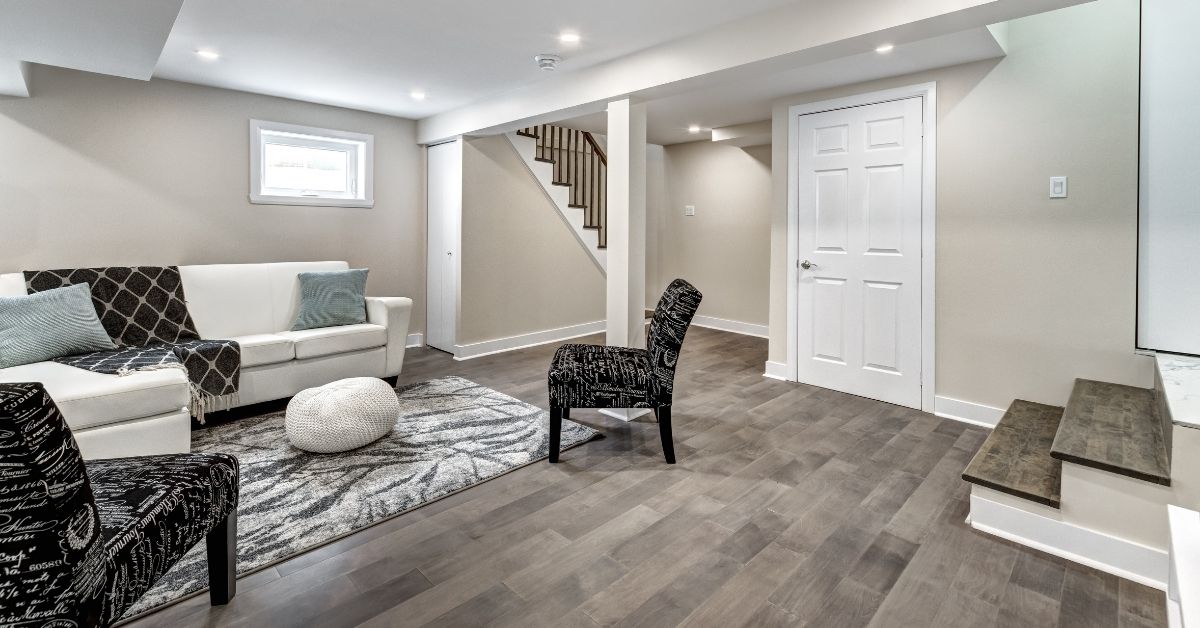
How Much Does It Cost to Finish a Basement?
Average size basement of 1000 sq ft costs $45000 – $55000 to finish up to building code and living standards. Therefore regular house basement renovation or finishing is $45 – $55 per square foot.
Like every construction project, basement job cost varies with selection of materials, quality of work, location and many other aspects.
Let’s break down and take a look at each stage during basement renovation and how much it all costs with different materials.
Our basement example will be 1000 sq ft place with 2 medium size bedrooms, 1 -3 piece bathroom, small kitchen and open area for entertainment.
In our calculations we are going to look at low end, medium and high end finishes for comparison reasons. Thus it would be easier to understand how to save money and where expenses drive up overall cost.
| Company with In-house | General Contractor | DIY Management | |
|---|---|---|---|
| Drawings & Permits | 0 | $1 000 | $2 500 |
| Demolition | 0 | $2 000 | $4 000 |
| Stairs & Railings | $1 000 | $2 000 | $4 000 |
| Plumbing | $1 000 | $2 000 | $3 000 |
| Electrical | $2 000 | $3 000 | $4 000 |
| Heating | $500 | $1 500 | $2 500 |
| Insulation | $2 500 | $2 500 | $3 500 |
| Drywall & Tape | $7 000 | $8 000 | $10 000 |
| Tiles | $1 000 | $1 500 | $2 000 |
| Flooring | $2 500 | $3 500 | $5 000 |
| Doors & Trims | $1 500 | $2 000 | $2 500 |
| Kitchen & Vanities | $3 000 | $5 000 | $15 000 |
| Painting & Stain | $3 500 | $4 500 | $5 500 |
| Hardware & Fixtures | $1 000 | $3 000 | $5 000 |
| Total Cost | $26 500 | $41 500 | $68 500 |
Cost table for basement renovation and finishing details does not include project management fee. This simply dictates how much each step would cost if trades were hired separately.
Hired Company or Builder Fee is 20%
Don’t hesitate to ask basement finishing contractor what is profit margin or markup added. It should not be a secret unless they are trying to hide things.
[instagram-feed]Cost of Permits and Drawings for Basement Finishing
First of all – do you need architectural drawings and city permits for finishing a basement? It all depends on local laws and amount of work involved.
In simple words, if basement finishing project includes structural changes or separate unit addition, most of regions require building permit.
If there is not obligation, Remodel On Point still recommends making architectural drawings with involvement of structural engineer.
Closing of walls with upgrades that does not assume new walls or plumbing installation usually can be completed without building inspections and permit.
Some home owners or remodeling companies still make a drawing to follow accurate scope of work.
Floor Plan and Architectural Drawings – Up to $2000
There are different options for drawings here and it all depends what each home owner is comfortable with.
Floor plan is needed for everyone to understand the scope of work and have exact boundaries. On paper it is easier to visualize and compare dimensions of each area. Just floor plan will not cost more than $200.
Architectural details and engineering specs are more for structural framer to follow. It explains full spectrum of work with precise measurements. Such documents can be up to $2000 and floor plan is not needed anymore.
City Permits – Up to $500
We find that many projects skip this very important step in the process. Home owners assume there is no requirement to finish basement in already built house.
This may be the case in some states/cities, but not everywhere. For 1000 sq ft basement finishing or renovation job city permit fees are not much. Usually its few hundred bucks with max tag of $500.
Cost to Finish Basement by Trade
Not everything we have listed here is going to be the same in your basement project. Some steps may not require any work at all.
This breakdown can be used for calculation of specific jobs and for home owners to balance budgets. Our team will try to explain specs of work with examples of sizes or quantity of materials needed.
Demolition and Tear Down Of Existing Walls $0 – $4000
Basement could be unfinished from original builder or have existing old walls with flooring that needs to be removed. Cost here depends on what was left over and how big of the job there is to demo.
Each bin of trash costs $400 to dispose. Small demolition job is just 1 bin and 1 full day of work for team of three or four.
Stairs and Railings $1000 – $4000
Low end projects can include only covering of old stairs with carpet or wood material, while higher end jobs require completely new custom stairs.
Railings go the same way and it can be as simple as wooden pickets to complicated metal or even glass rails.
Plumbing for Bathroom and Kitchen $1000 – $3000
In our example of 1000 sq ft basement we are assuming 1 bathroom that has 3 plumbing connections and kitchen with 2 more runs.
On average complete installation of each plumbing spot is $350 – $450 in the basement. This however changes with premade rough ins or very costly plumbing fixtures.
Electrical Outlets and Lights $2000 – $4000
Now this comes down to preference a lot. Average room can have a fixture light or 8 pot lights installed. Obviously dimmers, outlets with usb charges and other features cost more than regular switches and outlets.
Mid quality finish 1000 sq ft basement should have close to 22-28 pot lights and 20-25 receptacles. Low end basements can have only fewer lights but same amount of receptacles. Some basements already have wiring.
Heating for Each Room $500 – $2500
HVAC extensions are not expensive at all. It costs only few hundred dollars to add a shoulder of duct between floor joists. This is the benefit of having furnace in the house.
Radiators is completely different game. Adding new radiators for heat to each room can cost $300 – $400 per room.
Insulation of Walls $2500 – $3500
Basement walls need to be properly insulated with vapor barrier to protect interior from condensation and transferring cold weather.
Rigid and batts cost around $1.5 – $2 per square foot of wall to install. Spray foam will cost home owners double. In 1000 sq ft basement we assume exterior wall surface to be approximately 1100-1200 sq ft assuming 8 feet height and 10 inch pockets between joists.
Framing and Drywall $7000 – $10 000
Just like other stages we explained previously, basement may already have partial work completed. Builder could have completed the framing and if you are happy with position of the rooms it save money.
The only difference between mid and high end basement project is structural work. Custom framing may involve opening up rooms and beam installation that costs extra.
Tile Work with Materials $1000 – $2000
Amount of tiles is assumed the same in all three types of basement. Bathroom with tub has 80-90 sq ft of tiles on the walls and 30 sq of tiles on the floor. Don’t forget backslaps of kitchen and that is additional 20 sq ft.
If size is the same than our cost difference in tile installation is material itself and complexity of work. Tiles normally range from $2 per square foot to $20. Unique examples can go way higher in price.
Flooring of Basement $2500 – $5000
Subtracting bathroom, stairs and walls from overall space in our sample basement we get 900 sq ft of floor to be installed.
Normally because of dampness and colder temperature laminate is installed on the floor. Once again material cost ranges and additional underlayment can be used.
Doors and Trims $1500 – $2500
Team of carpenters take care of installing all doors, casings around windows and doors as well as baseboards.
Remodel On Point estimates 1000 sq ft basement has 7 doors, 5 windows and 300 linear feet of baseboards.
Vanity Cabinets & Kitchen $3000 – $15000
Having only one bathroom automatically means – count one vanity cabinet. For such a large space it vanity should be 36 – 48 inches.
Kitchen cabinets however are going to range a lot due to size and quality of material. Small kitchen made with Ikea cabinets can cost under $3 000, but larger size custom cabinets with quartz counter go as high as $15 000.
Painting and Stain $3500 – $5500
There will be no big difference between low, mid and high end basement finishing during painting and stain step. At least, not as big as other stages.
Variation comes down to openness of space and cost of selected paint. Trades may charge extra few hundred dollars if clients selects multiple colors of paint for walls.
Finish Hardware and Fixtures $1000 – $5000
Everyone seems to forget about hardware and fixtures that is required to finalize work. The cost is not huge but it does add up to how much does it cost to finish basement.
During this stage we are targeting bathroom towel and toilet paper holders, hvac covers, door stops, toilet, faucet drain cover and other things.
Cost to Finish Basement without Project Manager
When everyone sees that builder is making 20% on entire project, automatically come up a thought to manage project on your own.
But can you actually save 20% of all costs and how hard will it be to complete?
Reality shows that over 90% of home owners that start their own basement project end up hiring someone later on.
If you don’t know exact steps, details of quality control, good supplier with discounts and great trades; problems will start coming up really soon.
Trying to save few thousand dollars becomes a mess on a job and more money and time are lost. Construction and renovation companies have years of relationships with suppliers and best trades that do not give same prices to regular home owners.
Cost to finish basement on your own actually turns out to be slightly higher than with experienced project manager and lasts twice as long.
latest video

news via inbox
Nulla turp dis cursus. Integer liberos euismod pretium faucibua