
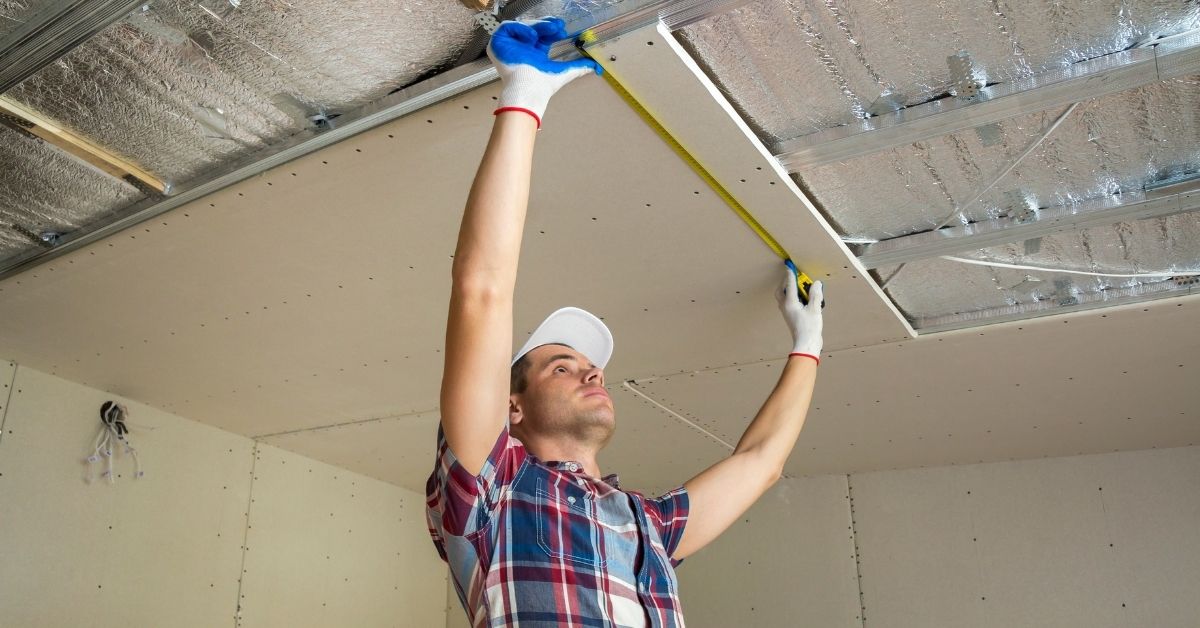
Calculate Drywall

How to Calculate Drywall for Any House or Office Project

Last Updated: 2022-02-16By

To calculate how much drywall is required for renovation or construction project you need to divide entire surface area of walls and ceiling by size of drywall sheet.

Easier said than done and in this topic Remodel On Point can teach you simple ways how to calculate drywall and what types of material used in different rooms or areas.

(Length of Walls  X  Height  +  Ceiling Area)  /  Drywall Sheet Size

Let’s not rush into this and make tons mistakes. The idea is to break it down so everyone can understand formula and follow it along.

  • Drywall size
  • Calculate Walls
  • Calculate ceilings
  • Do the math and add extras

In Example described below, 3000 square foot home requires 315 pieces of 4×8 drywall. 298 of them are regular drywall sheets, 13 green boards for bathrooms and 4 dense boards for gas fireplace.

[instagram-feed]

Drywall size

We are going to make it simple and start with most popular drywall sheet size – 8ft x 4 ft. Professionals like to mix all drywall sizes and use where appropriate.

For examples on ceilings of large rooms and open areas installers like 4 x 12 size. Rooms where drywall can be secured in stand up position it’s better to match the size of room height.

All other rooms are just a preference of drywall installers. It can be 8, 9, 10 or 12 foot long drywall boards. For our example we will just use 8 x 4 sheets which gives us 32 square feet of drywall coverage.

Size of DrywallTotal Square FeetWhere and When Used
4 x 832 sq ftUsed everywhere in construction industry. Most popular product and most sold.
4 x 936 sq ftWidely used in condo buildings as stand up installation and in regular bathrooms.
4 x 1040 sq ftInstalled horizontally in rooms that are smaller or equal to 10 feet in length.
4 x 1248 sq ftPreferred by installers in large open areas of the house for walls and ceilings.
4 x 1664 sq ftNot popular in home construction/renovation. Preferred for large commercial spaces.

Calculate Walls

The longest process is measuring every wall of the house. Deferent height of walls on each floor makes it ever harder.

We are talking about literally every wall. Every room has to be measured throughout. Very often people forget to measure inside of closets, near stairs, behind cabinets and installed fixtures.

In our example house we have 1500 square feet on main floor that is 10 feet high, and same size second floor with 9 foot ceiling. Don’t mix square footage with size of walls.

It takes up 30-45 minutes to measure walls. Main floor is mostly open and we have 240 linear feet times 10 foot height = 2400 sq ft.

Second floor has all the bedrooms, bathrooms and closets. Our average home has 520 linear feet of walls multiplied by 9 feet equals to 4680 sq ft.

Calculate ceilings

Technically there is no need to calculate ceiling surface if you know the size of house. Ceiling equals to square footage of floor area.

Because we assumed our example house is 3000 sq ft, than our ceiling surface area is 3000 sq ft.

Do the math and add extras

Not that we have all the numbers it’s as easy as adding them together and finalizing count. We got 3000 sq ft on ceiling, 2400 sq ft on all walls of main floor and 4680 sq ft on second.

3000 + 2400 + 4680 = 10080 sq ft – Full House interior surface area.

As we mentioned before, it is to be divided by size of drywall we want to use.

10080 / 32 = 315 –  Drywall Sheets

This is not over! Keep reading further details that we recommend including before making a final order.

Types of Drywall Needed for Each Area

Drywall is construction material made of gypsum and it works well for interior surface area. Its’ main purpose to cover open walls with rough ins as well as make perfectly smooth wall.

Drywall is not flammable and is considered to be one of the best materials for renovation projects. Besides variety of sizes it has several types.

Green Boards

Best installed in wet and humid areas of the house. This drywall has some resistance to moisture but is does not serve as waterproofing wall.

Recommended area for installation: bathrooms, laundry, utility room, indoor pool area, humid basements.

Fire Rated (type X)

With bylaws and building code improving every year, now we can create better fire protection for occupants. Drywall material was adjusted to have fire rating purpose.

Recommended area for installation: walls of house close to neighbor, commercial properties with multiple units, households split or design for multifamily occupancy.

Dense Boards

Regular fire rated drywall is not enough when there is wanted source of heat in the house and we want to keep it. Dense boards have much better purpose on fireplaces and similar heat projecting appliances.

Recommended area for installation: gas or wood burning fireplace.

Soundproof Quite Rock

Now we can insulate rooms or specific parts of building. Before it could only be done with sound rated insulation but not long ago soundproof drywall made it easy. The cost of it can be 5 – 8 times higher than regular drywall.

Recommended area for installation: between floors, home studio, dental or medical office.

Do You Need to Subtract for Windows and Doors?

After calculating length of each interior and exterior wall of the house and finalizing math we need to make sure everything is don’t by the book. The question we often hear is do you need to subtract material for windows and door openings?

It gets slightly complicated and there is not straight answer. If the house has 10-20 doors and regular or small size windows than don’t even bother.

Modern homes with floor to ceiling windows is a different story. Imagine full real wall of windows and patio door. Just measure largest windows or doors and subtract them from final formula.

Don’t forget to order a little extra material. Drywall does not need high percentage of waste to be included in purchase. We estimate that 5% of extra sheets would be enough for professional drywall installed, because don’t know how to cut and place boards without much waste.

Average Amount of Drywall Needed for House

This is not how drywall is calculated and we provide average material only for comparison or educational purpose.

Our team calculated drywall for 10 different houses and came up with average number of sheets required for installation. The magic number we got is 3.6. Meaning on average we would multiply square footage or size of home by 3.6 to get surface area of drywall.  For example for every 1000 sq ft of home we got 3600 square feet of drywall or just over 112 regular size sheets.

editor's pick

latest video

news via inbox

Nulla turp dis cursus. Integer liberos  euismod pretium faucibua

Each building has some sort of driveway or at least should have. The main reason is for vehicles to come closer without need to walk all the way. Some homes are residential with small driveway for their car to come in and park before garage or front entrance, and others can be large commercial buildings with loading docks, delivery entrances and casual parking entrances. On Point Remodeling was asked for suggestions on residential driveway for new home construction, and we decided to write detailed article for all our readers. Using this guide you can select the material for your driveway and see what works for your budget. Here are the materials for driveway we will be discussing in our guide:
  • Asphalt
  • Concrete
  • Paver Stone
  • Crushed stone
  • Brick
  • Seashell
  • Gravel
To find good contractor for your driveway, you can either ask our team by email or try to find someone local that worked with neighbors or nearby buildings.

Installation process of any material surface on your driveway

a) Demolition and Excavation – Before anything is done, your contractor will get heavy machinery and scratch off old layer of driveway. They need to go down at least 5-6 inches to insure proper layering before your final layer of material is installed. b) Material Purchase and Delivery – At this point your contract is signed and you already know how the surface will look. Contracting company purchases necessary materials and delivers them to site. Double check if material is correct and not damaged. c) Preparation of Sublevel – Whatever you place as final material, it cannot just be installed directly on top soil. Gravel is the first choice of material that goes down at this stage. Other preferred material is screen sand that can go on top of gravel and works better with stone and bricks. d) Compaction of Ground – To prevent your driveway from moving and changing shapes, all the layers from bottom up have to be properly compacted. Do not leave any spot untouched while doing this or you can get small holes and cracks in driveway after installation. E) Final Installation – This is when all the magic happens. After all preparations and dirty work the final installation is made literally within hours and you can enjoy new driveway. Stone and brick is set up by hand, while other materials require some sort of machinery with manual labor to even out surface.

1. Asphalt

Probably the most used material for road top surfaces as well as driveways is asphalt. This is a mix of gravel and sand that is mixed in and combined by asphalt cement with crude oil. Pros of Asphalt Driveway
  • Very popular and easy to find materials/contractor
  • Completed in 1 day and you can drive on it after
  • Patches and small holes can be fixed fast
Cons of Asphalt Driveway
  • Easy to damage and cracks appear in few years
  • Almost everyone else has same surface
  • Oily surface and chemicals used in mix
Prepared for asphalt driveway will cost you around $5 per square foot to finish. The contractors that take care of entire process from taking out old driveway surface, install subsurface and compact the ground with new asphalt on top, will charge on average $5500 per regular size driveway at single home property.

2. Concrete

What we call concrete is a mixture of Portland cement, aggregate as well as sand with gravel. Suggested thickness of concrete for driveway is 6 inches. The mixture needs to cure without being touched or driven on top for several days. Pros of Concrete Driveway
  • Durable material for large weights
  • Long lifespan if installed properly
  • Winter and summer friendly
Cons of Concrete Driveway
  • Has marks and stains over time
  • Hard to repair without replacement
  • Super hard to DIY
To hire contractors for concrete driveway it will cost around $7-$9 per square foot. This will include site preparation with gravel spread and new concrete installation. They will order full truck of concrete (or several for larger driveways) to pour inside forming. Smoothening and curing is required after installation.

3. Paver Stone

The most luxurious material that you can use to create driveway path with is paver stone. It is made out of natural stone with uneven rough shapes that have different line patterns. Paver stones are very heavy and are perfect for weights on top of them. Almost every city in Europe has roads and walks made out of stone that were installed centuries ago. Pros of Paver Stone Driveway
  • Creative designs can be done
  • Personal looks, can match the house
  • Can replace single stone in minutes
Cons of Paver Stone Driveway
  • Weeds growing through
  • Stone can move over time
  • Most expensive material
There is wide selection of stone that can be purchased for your driveway. On average we recommend settling with $17-$20 per square foot for stone with installation included. Working with this material is very intense labor and we recommend hiring professionals that do this type of work every day.

4. Crushed Stone

Our readers sometimes mistake crushed stone with gravel, but this is not the same material. Crushed stone material is achieved when machine is mechanically crushing larger pieces of unused stone for this specific purpose. It is larger than gravel and can have smooth finish. Crushed stone can also have a mix of colors, which is much pleasant to eyes than gravel. Pros of Crushed Stone Driveway
  • Low maintenance required
  • Fits rural area style
  • Can be reused for other purposes
Cons of Crushed Stone Driveway
  • Gets very hot during summer
  • Can be messy after many drives
  • Hard to remove snow and ice
Buying crushed stone and installing it on your driveway is as easy as it gets. Similar to other rough materials discussed in this post, only small tools like shovels, dolly and buckets are required to spread it on the road. The cost of crushed stone driveway is between $4 and $6 per square foot from professional local contractors that can finish the job in several days.

5. Brick

The same brick we see being used in wall construction can be installed as top driveway surface. Brick is manufactured by compressing clay with plastic mass. It is heated to extreme temperature and dried up to become as solid as you know it. Pros of Brick Driveway
  • Variety of selections in shapes and shades
  • Bricks are recyclable
  • Slip resistant with rough top part
Cons of Brick Driveway
  • Needs regular maintenance
  • Change color over time
  • Old fashion looking
Installing brick on driveway costs $10 per square foot, which is not too far from masonry brick laying as part of the wall. To save money you can use or purchase old brick, that was part of a wall before. Do not mix these two jobs and contact landscaping professionals instead of masonry contractors that work with bricks.

6. Seashell

This material is popular on the coast line where shells can be found near the water. Construction companies use seashells to add in other materials as well as spread them on driveway in rough condition, without adding anything else. It usually comes in white or pearl color and darkens within year because of mixing with sand and dirt. Pros of Seashell Driveway
  • Environmentally friendly
  • Has natural drainage
  • Creates worm vibe of beach house
Cons of Seashell Driveway
  • Break and crack under light weight
  • Sharp and very hard to walk on
  • Gets stuck in shoes and tires
To deliver and spread seashells on driveways costs below $4, which is only slightly more expensive than rough gravel. As you go further from coast line, cost of material increases due to delivery. This material is elegant and very soft. We recommend adding edge lines with darker color landscape material to create visual path.

7. Gravel

This material is used in other construction mixes and underlayment systems. It’s literally fragments and small crushed stones that are put on top of soil. It is easily spread out by hands and anyone can do it. Pros of Gravel Driveway
  • Cheapest of them all
  • Easy DIY Job
  • Can install another material on top
Cons of Gravel Driveway
  • Needs to be graded very often
  • Will mix with dirt and leaves
  • Washes up with heavy rains
It is rough material and can be purchased in bulk (by metric tons or cubic meters). The cost of driveway with gravel should not exceed $3 per square foot, but you can save tons of money by purchasing materials and doings installation by yourself. You do not require specific tools or heavy equipment for the job and delivery of gravel can be arranged directly to your project.

Conclusion

To properly finish any and all of these driveways requires skills and experience. There is no way you can complete any of these projects without heavy equipment and tools that regular home owner’s just store in their garages. Most of those who will read this post will prefer to install asphalt driveway, because of its popularity and low costs. We want to encourage home owners to go for personal preference and what matches your house, rather than getting the most affordable and popular items. Driveway jobs have to be completed fast; otherwise you will need to park elsewhere while the project is running. To not overpay, ask us for quotation sample on material you prefer in specific region where the work need to be done and our team can provide some numbers.

Leave A Comment