
4 Types of House Foundations with Costs and Advantages
There are four types of foundation used in residential home construction. All of them are used for different purposes or in regions suited for exact method. Here is a list:
- Basement Walls Foundation
- Slab on Grade Foundation
- Crawlspace Foundation
- Posts or Pile Foundation Support
Remodel On Point wants to break down pros and cons of each foundation method. If you are unsure which type of house foundation to use for your construction, ask our team and we can hell with full information.
Architectural drawing for each home construction or addition shows the method of how each foundation is built. It depends on budget costs and specific use of that space. Just like everything else, each selected type has pros in cons that we want to discuss.
Basement Foundation
Houses with basement foundation are much more popular in northern parts of the country. The main reasons being better construction conditions and use of space. In the south the soil is sandier, which creates difficulty for excavation and pouring concrete way deeper than ground level.
[instagram-feed]The water is another issue. Closer to south water usually sits just few feet below ground and basement excavation can create floods inside of the house.
Installation Method
It all starts from excavating large portion of soil with average depth of 10 feet. Concrete footings are poured that will support the whole house. Forms are set up on top of footings and poured with concrete inside. Rebar support may be required by engineer.
Another method of building basement foundation on top of footings is with cinder blocks. They are less popular due to more frequent leaks and being less durable material.
Because these foundation walls are underground, you want to protect them from water. Weeping tiles are put around perimeter of the house with exterior membrane attached to concrete walls. This directs any and all underground water into weeping tile system that collects and redirects it away from house.
Advantages of Basement Foundation
- Extra space – Imagine getting same amount of space as main floor, only directly below. Basement foundation provides extra space under grade level that can be finished and used as living area.
- Rental unit – Many home owners with finished basement can rent it out and get extra income from the same house. This is a great opportunity to pay off the house. Some builders deliberately chose basement foundations as a potential for second investment.
- Can build on sloped soil – Great way to construct house on ravine with main floor entrance at front and rear of the house entrance directly from basement. Hills and sloped grounds are great for this type of foundation.
- Shelter from natural disasters – If your area is known for earthquakes and tornadoes, basement is a great place to hide or wait out. Solid concrete walls positioned below ground level can withstand a lot.
Disadvantages of Basement Foundation
- More Expensive – It costs a lot of money to fully excavate and pour standard height basement foundation walls. It can be 3 times more expensive than slab on grade or crawlspace foundations.
- Not Suitable for Many Regions – Soil type and geographical position is a big factor in selection from 4 types of house foundations. Rocky soil is hard to excavate and basements are ruled out.
- More Likely to get Floods – 80% of foundation walls are placed below ground. Any underground water or rain streams can cause flood if not protected properly.
- Excavation – Like we already mentioned, homes with basements require deep excavation pit. The whole house perimeter is excavated 9-10 feet below ground level.
- Everything has to go Below – Imagine that your water and drain connection goes under concrete slab that is already 8 feet below ground. Connections to city line may be impossible or extremely complicated.
Construction Costs
To build these types of house foundation we need to consider and add costs of excavation and waterproofing system. On average expect 1500 sq ft basement foundation with footing and slab to cost around $55 000. It comes down to $36 per square foot.
Slab on Grade Foundation
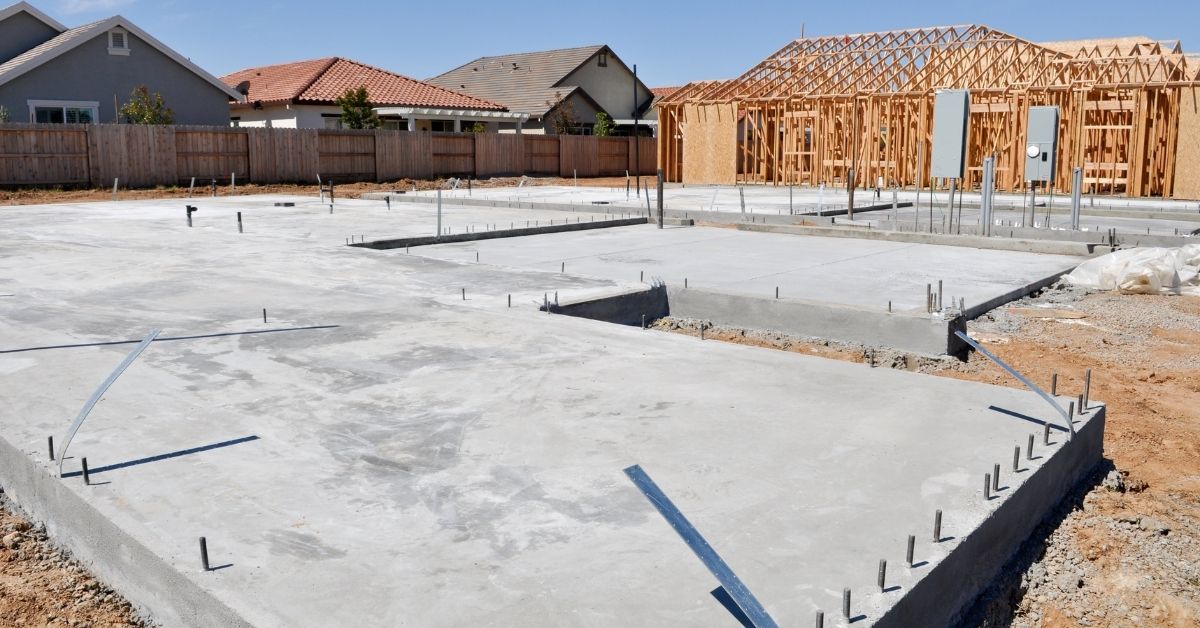
The simplest way to build a house is with slab on grade foundation. This method of foundation construction is used in south regions. Other ways may not be suitable for soil or more expensive to implement.
Installation Method
It means exactly what you think it means. Foundation with footings pour directly on top of evened out soil without much of excavation.
Imagine how garage is constructed with concrete base and footings. The process is the same, only thickness for house foundation is slightly thicker to withstand second floor without cracking. Additional rebar support can be installed for the same reason. It keeps concrete tight together and protects from damage.
Advantages of Slab on Grade Foundation
- No Steps – Without raised foundation there will be no steps into the house or maximum one step. It seems more comfortable for everyday use and carrying things inside.
- Low Costs – Comparing all types of house foundation we can easily say that slab on grade is the cheapest to install for new home. Spend your money on other luxury finishes in the house.
- Low Maintenance – Not much maintenance is required with single slab. There is no access to underneath; therefore you need only to take care of slab that is inside the house.
- Does not Flood – These types of house foundations are positioned on hill so the water does not go inside of the house from rains and even heavy storms.
Disadvantages of Slab on Grade Foundation
- Unavoidable Cracks – Within time concrete is going to crack regardless. It sits directly on top of soil and within few decades you will have to fix cracks on slab.
- Temperature Control – Concrete serves one of the best heat conductors. If the temperature is hot, your floor surface will be hot as well. In colder regions the slab will obviously be cold.
- Works Only on Flat Grounds – Unfortunately it is impossible to implement slab on grade foundation on sloped ground. It can be installed only on flat surfaces.
- Hard to Replace – Entire system of slab on grade foundation works as a support for house. Replacing the slab under structural walls is a pain and can cost quite a bit.
Construction Costs
Unlike other construction methods, slab on grade is easy to implement and literally anyone can do it. Therefore it is the cheapest of them all at $10 per square foot.
Crawlspace Foundation
House all over the country use crawlspace foundation as one of primary methods to build base for house.
This way homes can be built on flat or slightly elevated ground. Flexibility and budget construction have made it one of most popular types of house foundation in America.
Installation Method
It’s recommended to start with concrete footings, like any other construction. On top go cinder blocks around perimeter and some interior walls/posts to hold load points. Crawl space usually allows 2-4 feet under subfloor for maintenance and possibility to crawl.
First subfloor is set on blocks. Insulation can be required on bottom of the joists to prevent heat loss and infestation from crawlspace.
Advantages of Crawlspace Foundation
- Floors are Warmer – Indirect floor surface makes it easier to have warm floor at all times. There is empty space under main floor and with proper insulation even colder parts of country can have floors with average temperature.
- Easy Maintenance – Due to accessible area under main floor, it is easy to maintain and repair foundation for crawlspace. It may not be comfortable to do it, but access is there.
- Build on Most Soil Types – Construction does not require flat surface or deep excavation in these types of house foundation. It’s easy to adapt on most of lands and build new home using crawlspace method.
- Cheap and Easy Installation – Technique to install crawlspace is very easy. You don’t need concrete forms or complicated pouring machines. Simple installation of cinder blocks will do.
Disadvantages of Crawlspace Foundation
- Moisture Sensitive – Cinder block and exposed soil underneath can condensate moisture into joists of first subfloor. You won’t get floods, but wet ground underneath can speed up rotting of wood.
- Less Lifespan – Amount of yeas this type of foundation will serve without major repairs is 20% – 40% less than other concrete foundations.
- Unusable Space – Although raising most of the house by 3-4 feet from the ground, the space underneath is unusable. You can only temporarily store items that are not sensitive to moisture.
- Exposed Wood – Some regions are big on termites and other insects that feast on wood structures. Wood structure is exposed underneath and can be damaged.
Construction Costs
To build crawlspace foundation with cinder blocks on top of concrete footings it costs around $8-$9 per square foot. This seems even cheaper than slab on grade, but consider subfloor joists that are needed in crawlspace.
Pier and Beam Foundation
To build a house in most uncomfortable conditions, engineers came up with unique methods like piers and piles. Now homes can be constructed on unstable soil surfaces, sandy lands and even large stones.
Large building constructions in Dubai involved tens of concrete piers going deep below ground level, because top sand could not hold loads of buildings.
Installation Method
Pier or pile is a concrete support that goes deep underground level to give extra support for house foundation. Imagine that house is standing on tall concrete legs that go underground.
With rocky surface its even harder to implement. Wholes are made inside rocks and rebar attached to hold poured concrete piers. Idea is the same though.
Another implementation of this method is when you need to build house on water. Just like discussed above, piers or piles installed into ground below water. Wood, concrete and metal can be used for building above water.
Advantages of Pier and Beam Foundation
- Ability to Build Anywhere – This type of house foundation is used in areas where other methods cannot work. Its rather a solution to complicated landscapes than a choice of construction.
- House is Lifted – Besides piers and beams, there are no parts of the house that are in contact with soil, water or other natural materials. Therefore it is not affected by anything.
- Can Move House – If home owner decides it’s time to move, this type of house is probably the only that can be transported by heavy trucks. Piers are cut and entire home is moved to new lot.
- Repair and Maintenance – So the house stays intact and only piers need to be serviced. In worst case scenario new beams can be added to the house structure to support it and old ones removed.
Disadvantages of Pier and Beam Foundation
- High Costs – The amount of money required for these types of house foundation can be astronomical. Only after testing soil and engineering details you can estimate how much exactly it is.
- Required Engineering – Think of it as few legs support heavy house. Slight mistake in engineering details can cause the house tilt or even fall down.
- Risk of Sagging – Because the beams are very thing and heave load pressure is pushing them down, potentially one or few of them can sag down.
- Sensitive to Earthquakes – Already discussed how sensitive piers and beams are. Now imagine there is an earthquake that can shake things up. Even small shakes can flip the house upside down.
Construction on Piers Costs
This system is different from all listed before in our topic. Each job has unique situation. Piers and piles are detailed by engineer and costs depend on complexity of soil, depth of installation, size and quantity of piers. Expect each pier to cost on average $2000 with relatively easy installation conditions.
Consider All Types of House Foundation in Construction
Before taking out options that you may not like or that seem to expensive, consider consolation with professional builders and engineers.
It’s great to have options, but some types of house foundation may be necessary for your type of land or specific construction project.
For those of you who are stuck and need more suggestions, contact our team and we can help with the project.
latest video

news via inbox
Nulla turp dis cursus. Integer liberos euismod pretium faucibua