
How to Calculate Square Feet of a House and Measure It

How to Calculate Square Feet of a House and Measure It

Last Updated: 2021-08-11By

To measure the living space of your home, you need to follow a few simple rules. For a start, you should have on hand all the items you need for this. First of all, you will need any kind of device that measures distance or length. It can be a measuring tape or a laser.

You will also need a piece of paper and a pen to write down the measurements that appear. For simpler calculations, you should have a calculator at hand, because you will have to multiply and add complex numbers.

When you already have all the necessary tools, let’s move on to how to measure square footage of a house. For a simpler example, consider a house with an even rectangle shape. To find out the area of ​​any surface, you need to know its width and length. After that, the resulting numbers must be multiplied and you will get your surface area in square feet.

Let’s Divide the Measurement Process into Stages

Unfortunately, it will be a little more difficult to measure our houses or apartments because they have many different rooms. To simplify the task, on a piece of paper, draw a rough drawing of your house with all the rooms and corridors. After that, measure each room separately and count their areas. To find out the total area of ​​the house, you only need to add up the areas of all rooms.

Sometimes there are more complex cases, for example, how to calculate square feet of a house if one or more rooms have a rounded shape? In such rare cases, more complex mathematical measurements are needed but don’t worry. There is a good chance that the city government has blueprints for your house or apartment. These drawings usually show all the dimensions you need. If you built a house by hiring a construction company, then perhaps these drawings are stored at your home and you can use them.

[instagram-feed]

How to Calculate Square Feet of a House with Few Floors

Sometimes people make a simple mistake when measuring the area of ​​a house with several floors. Do not think that if the exchanges of the first and second floors look the same, then the area will also be the same.

This is a common mistake because due to the different layouts of rooms on the floors, their total area may differ. This may be due to the presence of additional walls or, for example, part of the first floor will be occupied by a garage.

So how to measure square footage of a house with two or more floors. It’s quite simple, you need to draw each floor on a separate sheet of paper. After carrying out all the measurements that we described above, you will receive the area of ​​each floor separately.

After that, to find out the total area of ​​the house, you will need to sum up the areas of each floor. Remember that each floor must be counted separately, whether you have two, three, or more floors in your house.

What Devices to Use for Measurements?

Nowadays, there are several types of measuring instruments for determining the length of the room, which are easy to use. They are used by all builders and you cannot do without them if you are going to calculate the square footage of a house.

Measure Tape

Measure tape is considered the most common device. Its popularity is due to its ease of use and low price. This is an indispensable tool that may be needed in any home, regardless of whether you are measuring the length of a room or any other object. Also, the price plays an important role, it is much lower than that of other measuring devices and is $ 10 – 15.

Laser Measure

The laser distance measure is a more modern version of a measuring device. If you are wondering how to calculate square feet of a house with this fixture, then the answer is, very simple. With a laser, you get the most accurate measurements effortlessly.

The additional functions of the device will allow you to immediately calculate the area of ​​a room of any shape. But since this is an electronic device, its price will differ significantly. Depending on the company and the set of functions, it can be $ 50-200, which is much higher than that of the measuring tape.

Measuring Wheel

The measuring wheel is also often used to calculate the distance. This is an excellent device, but it should be understood that it will not be quite convenient inside the house due to its size. If you need to measure the outer dimensions of the house, then this device can help you. Its price is $ 50 – $ 100, depending on the size and manufacturer.

Which Rooms are not Living Spaces in the House?

Living space is a very important factor when buying a home. But as with any measurements, it is worthwhile to correctly understand what exactly to relate to living space in the house. Firstly, it is worth excluding the balcony and deck, the size of these parts of the house should not be taken into account, the same applies to the garage.

For example, the house is built in such a way that the garage occupies part of the first floor and has a separate entrance from inside the house. In this case, the garage is located in the aisles of the house, but it should be understood that this is a separate room.

What about Basement and Attic?

As for premises such as attic and basement, everything will depend on the laws adopted in your state. For example, your house is built on a slope and part of it will be visible as an additional floor. In this case, the house can be considered an exception and the basement square can be added to the total area of ​​the house.

Even the height of rooms can affect the increase in the size of the living space. If the layout of your house includes a living room of two floors, then in some cases its area can be considered double.

If your home has these features and you are in doubt about how to measure square footage of a house, Remodel on point recommends that you contact your local real estate appraiser. These specialists know in detail all the subtleties in your state and city to provide you with a detailed answer.

An Example of how to Measure Square Footage of a House
How to measure house

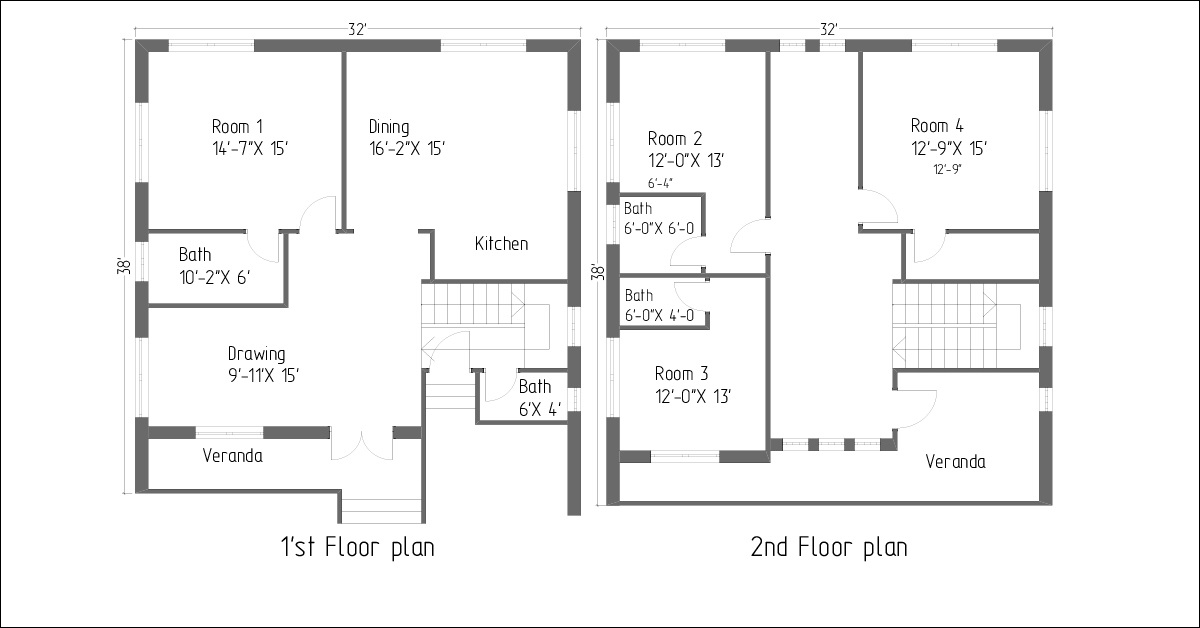
At first glance, all these calculations can be confusing. For a more illustrative example, Remodel on point invites you to consider how to calculate square feet of a house using a drawing example. We have chosen an accurate drawing made in electronic form for a clearer understanding of the written. You will have a blank sheet of paper where you draw by hand the outer walls of your house, as well as the interior walls.

For a simpler understanding of what is shown in your drawing, you can sign each room as it is done in the picture. After that, you will need to measure the length and width of each room. The results of these measurements can be recorded under the name of the room so that there is no confusion and nothing to miss. You can also immediately multiply these numbers and enter the values ​​immediately in square feet into the drawing.

After you measure all the rooms, you just have to add up the areas of each room and you will get the total living space in your home. It is also worth noting that in the figure we did not count the dimensions of the veranda. This is because although it is part of the house, it is not a living space. We would like to remind you that the attic, garage, basement, and some other parts of the house may also not be considered living space, except in rare cases.

What if Measure Square Footage of a House from Outside?

Based on this, we see that if you calculate square feet of a house outside, then you will only get the total area of ​​the building and not a living space. It should also be understood that in addition to additional rooms, which should not be taken into account, the thickness of the outer walls will also play a role in the dimensions.

For example, consider a house measuring 25 x 40 feet. If we count from the outside, that’s 1000 square feet per floor. Exterior walls are on average 8 to 9 inches thick. Based on this, the actual dimensions of the house will be approximately 23.5 x 38.5 feet, and multiplying these values ​​we get 904.75 square feet, which is already a difference of 5% of the total area of ​​the house.

Such seemingly small details can play an important role in the correctness of the calculations. We have tried to give you all the details on how to measure square footage of a house. If you stick to the tips above, calculating the square footage of a house will be pretty straightforward.

editor's pick

latest video

news via inbox

Nulla turp dis cursus. Integer liberos  euismod pretium faucibua

Each building has some sort of driveway or at least should have. The main reason is for vehicles to come closer without need to walk all the way. Some homes are residential with small driveway for their car to come in and park before garage or front entrance, and others can be large commercial buildings with loading docks, delivery entrances and casual parking entrances. On Point Remodeling was asked for suggestions on residential driveway for new home construction, and we decided to write detailed article for all our readers. Using this guide you can select the material for your driveway and see what works for your budget. Here are the materials for driveway we will be discussing in our guide:
  • Asphalt
  • Concrete
  • Paver Stone
  • Crushed stone
  • Brick
  • Seashell
  • Gravel
To find good contractor for your driveway, you can either ask our team by email or try to find someone local that worked with neighbors or nearby buildings.

Installation process of any material surface on your driveway

a) Demolition and Excavation – Before anything is done, your contractor will get heavy machinery and scratch off old layer of driveway. They need to go down at least 5-6 inches to insure proper layering before your final layer of material is installed. b) Material Purchase and Delivery – At this point your contract is signed and you already know how the surface will look. Contracting company purchases necessary materials and delivers them to site. Double check if material is correct and not damaged. c) Preparation of Sublevel – Whatever you place as final material, it cannot just be installed directly on top soil. Gravel is the first choice of material that goes down at this stage. Other preferred material is screen sand that can go on top of gravel and works better with stone and bricks. d) Compaction of Ground – To prevent your driveway from moving and changing shapes, all the layers from bottom up have to be properly compacted. Do not leave any spot untouched while doing this or you can get small holes and cracks in driveway after installation. E) Final Installation – This is when all the magic happens. After all preparations and dirty work the final installation is made literally within hours and you can enjoy new driveway. Stone and brick is set up by hand, while other materials require some sort of machinery with manual labor to even out surface.

1. Asphalt

Probably the most used material for road top surfaces as well as driveways is asphalt. This is a mix of gravel and sand that is mixed in and combined by asphalt cement with crude oil. Pros of Asphalt Driveway
  • Very popular and easy to find materials/contractor
  • Completed in 1 day and you can drive on it after
  • Patches and small holes can be fixed fast
Cons of Asphalt Driveway
  • Easy to damage and cracks appear in few years
  • Almost everyone else has same surface
  • Oily surface and chemicals used in mix
Prepared for asphalt driveway will cost you around $5 per square foot to finish. The contractors that take care of entire process from taking out old driveway surface, install subsurface and compact the ground with new asphalt on top, will charge on average $5500 per regular size driveway at single home property.

2. Concrete

What we call concrete is a mixture of Portland cement, aggregate as well as sand with gravel. Suggested thickness of concrete for driveway is 6 inches. The mixture needs to cure without being touched or driven on top for several days. Pros of Concrete Driveway
  • Durable material for large weights
  • Long lifespan if installed properly
  • Winter and summer friendly
Cons of Concrete Driveway
  • Has marks and stains over time
  • Hard to repair without replacement
  • Super hard to DIY
To hire contractors for concrete driveway it will cost around $7-$9 per square foot. This will include site preparation with gravel spread and new concrete installation. They will order full truck of concrete (or several for larger driveways) to pour inside forming. Smoothening and curing is required after installation.

3. Paver Stone

The most luxurious material that you can use to create driveway path with is paver stone. It is made out of natural stone with uneven rough shapes that have different line patterns. Paver stones are very heavy and are perfect for weights on top of them. Almost every city in Europe has roads and walks made out of stone that were installed centuries ago. Pros of Paver Stone Driveway
  • Creative designs can be done
  • Personal looks, can match the house
  • Can replace single stone in minutes
Cons of Paver Stone Driveway
  • Weeds growing through
  • Stone can move over time
  • Most expensive material
There is wide selection of stone that can be purchased for your driveway. On average we recommend settling with $17-$20 per square foot for stone with installation included. Working with this material is very intense labor and we recommend hiring professionals that do this type of work every day.

4. Crushed Stone

Our readers sometimes mistake crushed stone with gravel, but this is not the same material. Crushed stone material is achieved when machine is mechanically crushing larger pieces of unused stone for this specific purpose. It is larger than gravel and can have smooth finish. Crushed stone can also have a mix of colors, which is much pleasant to eyes than gravel. Pros of Crushed Stone Driveway
  • Low maintenance required
  • Fits rural area style
  • Can be reused for other purposes
Cons of Crushed Stone Driveway
  • Gets very hot during summer
  • Can be messy after many drives
  • Hard to remove snow and ice
Buying crushed stone and installing it on your driveway is as easy as it gets. Similar to other rough materials discussed in this post, only small tools like shovels, dolly and buckets are required to spread it on the road. The cost of crushed stone driveway is between $4 and $6 per square foot from professional local contractors that can finish the job in several days.

5. Brick

The same brick we see being used in wall construction can be installed as top driveway surface. Brick is manufactured by compressing clay with plastic mass. It is heated to extreme temperature and dried up to become as solid as you know it. Pros of Brick Driveway
  • Variety of selections in shapes and shades
  • Bricks are recyclable
  • Slip resistant with rough top part
Cons of Brick Driveway
  • Needs regular maintenance
  • Change color over time
  • Old fashion looking
Installing brick on driveway costs $10 per square foot, which is not too far from masonry brick laying as part of the wall. To save money you can use or purchase old brick, that was part of a wall before. Do not mix these two jobs and contact landscaping professionals instead of masonry contractors that work with bricks.

6. Seashell

This material is popular on the coast line where shells can be found near the water. Construction companies use seashells to add in other materials as well as spread them on driveway in rough condition, without adding anything else. It usually comes in white or pearl color and darkens within year because of mixing with sand and dirt. Pros of Seashell Driveway
  • Environmentally friendly
  • Has natural drainage
  • Creates worm vibe of beach house
Cons of Seashell Driveway
  • Break and crack under light weight
  • Sharp and very hard to walk on
  • Gets stuck in shoes and tires
To deliver and spread seashells on driveways costs below $4, which is only slightly more expensive than rough gravel. As you go further from coast line, cost of material increases due to delivery. This material is elegant and very soft. We recommend adding edge lines with darker color landscape material to create visual path.

7. Gravel

This material is used in other construction mixes and underlayment systems. It’s literally fragments and small crushed stones that are put on top of soil. It is easily spread out by hands and anyone can do it. Pros of Gravel Driveway
  • Cheapest of them all
  • Easy DIY Job
  • Can install another material on top
Cons of Gravel Driveway
  • Needs to be graded very often
  • Will mix with dirt and leaves
  • Washes up with heavy rains
It is rough material and can be purchased in bulk (by metric tons or cubic meters). The cost of driveway with gravel should not exceed $3 per square foot, but you can save tons of money by purchasing materials and doings installation by yourself. You do not require specific tools or heavy equipment for the job and delivery of gravel can be arranged directly to your project.

Conclusion

To properly finish any and all of these driveways requires skills and experience. There is no way you can complete any of these projects without heavy equipment and tools that regular home owner’s just store in their garages. Most of those who will read this post will prefer to install asphalt driveway, because of its popularity and low costs. We want to encourage home owners to go for personal preference and what matches your house, rather than getting the most affordable and popular items. Driveway jobs have to be completed fast; otherwise you will need to park elsewhere while the project is running. To not overpay, ask us for quotation sample on material you prefer in specific region where the work need to be done and our team can provide some numbers.

Leave A Comment